

Major Industry Recruiters


Major Industry Recruiters
Course Description:
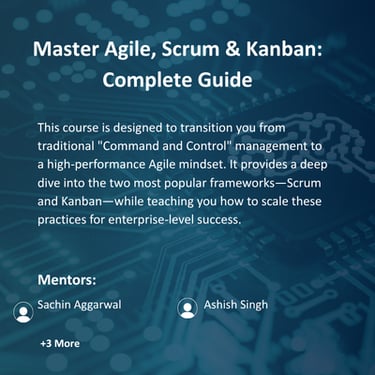
This course is designed to transition you from traditional "Command and Control" management to a high-performance Agile mindset. It provides a deep dive into the two most popular frameworks—Scrum and Kanban—while teaching you how to scale these practices for enterprise-level success.
Course Module:
Module 1: The Agile Mindset
The Manifesto: Breaking down the 4 Values and 12 Principles.
Agile vs. Waterfall: Understanding the shift from predictive to adaptive planning.
Empiricism: Transparency, Inspection, and Adaptation.
Module 2: The Scrum Framework
Scrum Roles: The Product Owner, Scrum Master, and Developers.
Scrum Artifacts: Product Backlog, Sprint Backlog, and the Increment (Definition of Done).
Scrum Events: Mastering the rhythm of the Sprint.
Module 3: Kanban & Flow Management
The 6 Practices of Kanban: Visualizing work and making policies explicit.
WIP Limits: How restricting work actually increases throughput.
Kanban Boards: Designing a board that reflects your specific value stream.
Module 4: Agile Estimation & Planning
User Stories: Using the INVEST criteria and 3C’s (Card, Conversation, Confirmation).
Relative Estimation: Story Points, Planning Poker, and T-Shirt Sizing.
Release Planning: Mapping out the long-term vision in an uncertain environment.
Module 5: Agile Metrics & Continuous Improvement
Tracking Scrum: Burn-down/up charts and Velocity.
Tracking Kanban: Lead Time, Cycle Time, and Throughput.
The Retrospective: Advanced techniques to keep the team evolving.
Course Objective:
The goal is to move beyond "doing" Agile to "being" Agile. By the end of this course, participants will be able to:
Facilitate all Scrum Events: Master the art of Sprint Planning, Daily Stand-ups, Reviews, and Retrospectives.
Optimize Workflow with Kanban: Visualize work, limit Work-in-Progress (WIP), and manage flow to improve lead times.
Write High-Value Requirements: Create impactful User Stories and manage a prioritized Product Backlog.
Navigate Hybrid Environments: Learn when to use Scrum, when to use Kanban, and how to blend them (Scrumban).
Measure Real Progress: Use Agile metrics like Velocity, Burn-down charts, and Cumulative Flow Diagrams (CFD) to drive data-backed decisions.

Upcoming Batches: Choose as per Your Requirement
Our Mentors:
Richa Gupta


PMP
Sachin kumar
ATP Instructor, PMP
Ahmed Khan
PMP
Abhishek Singh
PMP
Our Mentors:

Richa Gupta
Cloud Engineer in Wipro
Aina Rathor
DevOps Engineerex-Deloitte
Ahmed Khan
Coud Engineer in Cognizant
Coud Engineer in IBM
Abhishek Singh
Our Alumni Work at Top Companies





























Frequently Asked Questions (FAQs)
1. Is this course for IT professionals only? No. While Agile started in software, these modules apply to marketing, HR, manufacturing, and any field requiring rapid adaptation to change.
2. Does this prepare me for certifications? Yes. The content is aligned with the core knowledge required for PSM I (Professional Scrum Master) and PSPO (Professional Scrum Product Owner), as well as general Agile practitioner exams.
3. What is the main difference between Scrum and Kanban covered in the course? We teach Scrum as a structured, time-boxed framework (Sprints) and Kanban as a continuous, flow-based method. You will learn how to choose the right one based on your team's nature of work.
4. Do we learn about tools like Jira or Trello? The course focuses on the methodology, but we use digital board demonstrations to show how these concepts are applied in popular Agile management software.
5. How long is the course? Depending on the delivery format, this is typically structured as a 16-hour intensive (either a 2-day workshop or 4-week part-time program).
Our Programs
© 2025 GIMIT | All rights Reserved