



Major Industry Recruiters




Major Industry Recruiters
Course Description:
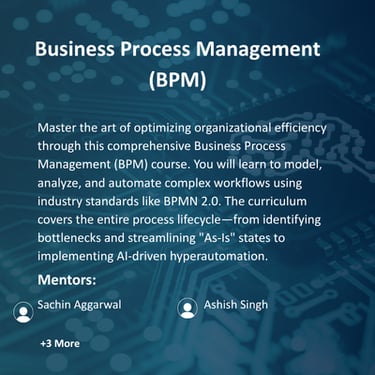
Master the art of optimizing organizational efficiency through this comprehensive Business Process Management (BPM) course. You will learn to model, analyze, and automate complex workflows using industry standards like BPMN 2.0. The curriculum covers the entire process lifecycle—from identifying bottlenecks and streamlining "As-Is" states to implementing AI-driven hyperautomation. Gain the strategic tools needed to align operational performance with business goals and drive continuous digital transformation across any enterprise.
Course Module:
Here is a structured breakdown of the Business Process Management (BPM) course modules, designed to take learners from foundational theory to advanced digital execution.
Module 1: Introduction to Process-Centric Thinking
The BPM Philosophy: Understanding processes as corporate assets.
BPM Lifecycle: From discovery and analysis to automation and monitoring.
Organizational Maturity: Assessing where a company stands on the BPM maturity scale.
Module 2: Process Modeling with BPMN 2.0
The Language of BPM: Mastering flow objects (events, activities, gateways).
Connecting Objects: Using sequence, message, and association flows.
Swimlanes & Pools: Defining roles, responsibilities, and inter-departmental handoffs.
Decomposition: Breaking down high-level processes into sub-processes and tasks.
Module 3: Qualitative & Quantitative Analysis
Identifying Waste: Applying Lean principles to find non-value-added steps.
Root Cause Analysis: Using Pareto charts, Fishbone diagrams, and the "5 Whys."
Flow Analysis: Calculating cycle times, waiting times, and theoretical capacity.
Process Simulation: Using data to predict how "To-Be" changes will impact performance.
Module 4: Process Redesign & Optimization
Design Heuristics: Strategies for reducing lead times and increasing quality.
The "As-Is" vs. "To-Be": Bridging the gap between current reality and future goals.
Customer-Centric Design: Mapping the "Outside-In" perspective (Customer Journey Mapping).
Module 5: Automation & Digital Transformation
The Automation Stack: Differentiating between BPMS, Case Management, and RPA.
Low-Code/No-Code: Empowering "Citizen Developers" to build workflows.
Hyperautomation: Integrating AI, Machine Learning, and Decision Management into processes.
Module 6: Process Mining & Intelligence
Data-Driven Discovery: Using event logs to visualize how processes actually run.
Conformance Checking: Identifying where reality deviates from the intended model.
Operational Intelligence: Setting up real-time dashboards for continuous monitoring.
Module 7: BPM Governance & Strategy
Aligning with KPIs: Linking process performance to strategic business outcomes.
The BPM Office: Establishing a Center of Excellence (CoE).
Change Management: Navigating the human element of process transformation.
Module 8: Capstone Project
Real-World Application: Participants select a "broken" process, model it, analyze the bottlenecks, and propose a redesigned, automated solution.
Course Objective:
Master Process Modeling: Gain proficiency in BPMN 2.0 to create standardized, clear visualizations of complex business operations.
Analyze & Optimize Performance: Apply quantitative and qualitative techniques to identify bottlenecks, reduce cycle times, and eliminate operational waste.
Bridge the Strategy-Execution Gap: Align day-to-day processes with high-level corporate goals through the use of KPIs and Process Performance Indicators (PPIs).
Leverage Emerging Technologies: Evaluate and implement modern automation solutions, including RPA, Process Mining, and AI-driven hyperautomation.
Lead Change Management: Develop the leadership skills necessary to foster a culture of continuous improvement and manage the transition from "As-Is" to "To-Be" states.
Build Governance Frameworks: Establish a BPM Center of Excellence (CoE) to ensure long-term process maturity and cross-departmental agility.

Upcoming Batches: Choose as per Your Requirement
Our Mentors:
Richa Gupta


PMP
Sachin kumar
ATP Instructor, PMP
Ahmed Khan
PMP
Abhishek Singh
PMP
Our Mentors:

Richa Gupta
Cloud Engineer in Wipro
Aina Rathor
DevOps Engineerex-Deloitte
Ahmed Khan
Coud Engineer in Cognizant
Coud Engineer in IBM
Abhishek Singh
Our Alumni Work at Top Companies













































Frequently Asked Questions (FAQs)
1. Who should enroll in this course? This course is designed for project managers, business analysts, operations leads, IT professionals, and department heads who want to improve efficiency, reduce costs, and lead digital transformation initiatives within their organizations.
2. Are there any prerequisites? There are no strict technical prerequisites. However, a basic understanding of how your organization’s departments interact and some experience with professional workflows will help you get the most out of the modeling and analysis modules.
3. Does this course cover specific software? While the course is "vendor-neutral"—meaning the principles apply to any platform—we provide hands-on demonstrations using industry-leading tools for BPMN 2.0 modeling, RPA (Robotic Process Automation), and Process Mining.
4. How much of the course is focused on automation? About 30-40% of the curriculum is dedicated to automation. We believe you cannot effectively automate a "broken" process, so we prioritize process discovery and optimization before moving into Hyperautomation and AI integration.
5. What is the difference between BPM and Lean Six Sigma? While both aim for improvement, BPM focuses on the end-to-end management of repeatable processes and technical automation. Lean Six Sigma is more focused on reducing variability and defects using statistical methods. This course incorporates Lean tools but views them through a BPM lifecycle lens.
6. Is BPMN 2.0 difficult to learn? BPMN 2.0 is the global standard for process modeling. While it has many symbols, this course focuses on the core elements used in 90% of business scenarios, making it accessible even for those without a technical background.
7. How will this course help my career? BPM expertise is a high-demand skill. You will be able to quantify your value by showing exactly how much time or money a process redesign has saved. This makes you a strong candidate for roles like Process Architect, Operations Director, or Digital Transformation Consultant.
8. Will I receive a certificate upon completion? Yes, all participants who complete the modules and the capstone project will receive a Certificate of Completion that can be shared on professional networks like LinkedIn.
9. Can this course be customized for corporate teams? Absolutely. For group enrollments, we can tailor the case studies to your specific industry—whether that is finance, manufacturing, healthcare, or government services.

Our Programs
© 2025 GIMIT | All rights Reserved