
Major Industry Recruiters


Major Industry Recruiters
Course Description:
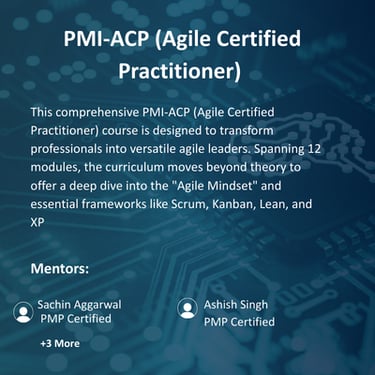
This comprehensive PMI-ACP (Agile Certified Practitioner) course is designed to transform professionals into versatile agile leaders. Spanning 12 modules, the curriculum moves beyond theory to offer a deep dive into the "Agile Mindset" and essential frameworks like Scrum, Kanban, Lean, and XP. You will master the seven core domains—from Value-Driven Delivery and Stakeholder Engagement to Adaptive Planning and Continuous Improvement. With 28 contact hours of expert-led content, the course provides practical tools like Value Stream Mapping and Fishbone Diagrams to resolve real-world bottlenecks.
Course Module: PMI-ACP (Agile Certified Practitioner)
Section 1: Foundations and Frameworks
Module 1: The ACP Mindset & Getting Started
Understanding the PMI-ACP Exam Blueprint and Application Process.
The Agile Manifesto: Deep dive into the 4 Values and 12 Principles.
Defining "Agile" beyond the buzzwords.
Module 2: Scrum Deep Dive
The Scrum Framework: Pillars (Transparency, Inspection, Adaptation) and Values.
Roles and Artifacts: Product Owner, Scrum Master, Developers, and Backlogs.
Scrum Ceremonies: Sprint Planning, Daily Scrum, Review, and Retrospective.
Module 3: Lean, Kanban, and XP
Lean Software Development: Eliminating the 7 Wastes (Muda).
Kanban Fundamentals: Pull systems, WIP limits, and managing flow.
Extreme Programming (XP): Pair Programming, TDD, and Continuous Integration.
Section 2: The Seven Domains of Practice
Module 4: Value-Driven Delivery (Domain 2)
Prioritization techniques: MoSCoW, Kano Model, and Relative Ranking.
Agile Metrics: ROI, NPV, and Earned Value Management (EVM) for Agile.
Managing Technical Debt and the Cost of Quality.
Module 5: Stakeholder Engagement (Domain 3)
Building a Shared Vision: Project Charters and Personas.
Communication Tools: Information Radiators and Wireframes.
User Stories: INVEST criteria and Story Mapping.
Module 6: Boosting Team Performance (Domain 4)
Team Formation: Tuckman’s Model and building cross-functional teams.
Coaching and Mentoring: Servant Leadership and Emotional Intelligence.
Performance Tracking: Velocity and Burndown/Burnup Charts.
Module 7: Adaptive Planning (Domain 5)
Levels of Agile Planning (The Planning Onion).
Estimation: Story Points, Planning Poker, and Affinity Estimating.
Timeboxing and Progressive Elaboration.
Module 8: Problem Detection & Resolution (Domain 6)
Root Cause Analysis: The 5 Whys and Fishbone (Ishikawa) Diagrams.
Risk Management: Risk-Adjusted Backlogs and Risk Burndown Charts.
Module 9: Continuous Improvement (Domain 7)
The Kaizen Philosophy and Process Tailoring.
Advanced Retrospectives and Value Stream Mapping.
Section 3: Advanced Topics and Certification Prep
Module 10: Scaling Agile & Other Frameworks
Scaling Frameworks: SAFe, LeSS, and Scrum of Scrums.
Hybrid Agile and Organizational Change Management.
Module 11: PMI-ACP Exam Strategy
Decoding Exam Patterns and Elimination Techniques.
Mastering the "Agile Mindset" Answer Key.
Module 12: Final Mock Exam & Career Guidance
Full Mock Exam with Deep Dive Analysis.
Post-Certification: LinkedIn updates and Agile Interview Tips.
Course Objective:
Key learning goals include:
· Methodological Mastery: Gaining deep proficiency in Scrum, Lean, Kanban, and Extreme Programming (XP) to select the best framework for any project.
· Value Optimization: Learning to prioritize high-value features using MoSCoW and Kano models to ensure maximum ROI.
· Team Leadership: Developing servant leadership skills to foster high-performing, self-organizing teams through effective coaching and conflict resolution.
· Adaptive Planning: Mastering empirical estimation and rolling wave planning to maintain flexibility without sacrificing quality.
· Exam Readiness: Fulfilling the 28-contact-hour requirement while mastering exam strategies to secure the PMI-ACP® certification.

Upcoming Batches: Choose as per Your Requirement
Our Mentors:
Richa Gupta


PMP
Sachin kumar
ATP Instructor, PMP
Ahmed Khan
PMP
Abhishek Singh
PMP
Our Mentors:

Richa Gupta
Cloud Engineer in Wipro
Aina Rathor
DevOps Engineerex-Deloitte
Ahmed Khan
Coud Engineer in Cognizant
Coud Engineer in IBM
Abhishek Singh
Our Alumni Work at Top Companies











































Frequently Asked Questions (FAQs) for the PMI-PBA Course
1. What are the requirements to take the PMI-ACP exam? To qualify, you need a secondary degree (high school diploma or associate degree), 21 contact hours of agile training, and 12 months of general project experience within the last 5 years. If you don't have a PMP or PgMP, you also need 8 months of agile project experience within the last 3 years.
2. How do I get the 28 contact hours required for this course? You earn the certificate by completing all video lectures, quizzes, and the final mock exam within the course modules. This exceeds the PMI minimum of 21 hours to ensure full coverage of the seven domains.
3. Does the course cover Scrum only? No, the PMI-ACP is "agnostic." While it includes a deep dive into Scrum, it also covers Lean, Kanban, Extreme Programming (XP), and other frameworks like Crystal and DSDM.
4. What is the "Agile Mindset" and why is it important? The Agile Mindset refers to the 4 values and 12 principles of the Agile Manifesto. It is the foundation of the exam; PMI tests your ability to think like an agile practitioner rather than just memorizing tools.
5. What is the difference between a User Story and a Task? A User Story describes a feature from the end-user's perspective using the INVEST criteria. Tasks are the technical steps the developers take to complete that story.
6. How does the exam handle math questions? The exam includes calculations for Agile Earned Value Management (EVM), such as CPI and SPI, as well as financial metrics like ROI, NPV, and IRR. The course includes dedicated practice for these formulas.
7. What is "Technical Debt"? Technical debt refers to the long-term cost of choosing an easy, quick solution now instead of a better approach that takes longer. Managing this is crucial for maintaining agility.
8. What happens if my application is audited by PMI? Audits are random. If selected, you must provide copies of your diploma, signatures from supervisors for your experience, and your 28-hour training certificate. The course provides a guide on how to avoid common audit triggers.
9. How many questions are on the exam and how long do I have? The exam consists of 120 multiple-choice questions, and you have 3 hours to complete it. 20 of these questions are "pre-test" questions and do not affect your score.
10. How do I maintain my PMI-ACP certification after passing? To keep your certification active, you must earn 30 professional development units (PDUs) in agile topics every three years.

Our Programs
© 2025 GIMIT | All rights Reserved