




Major Industry Recruiters




Major Industry Recruiters
Course Description:
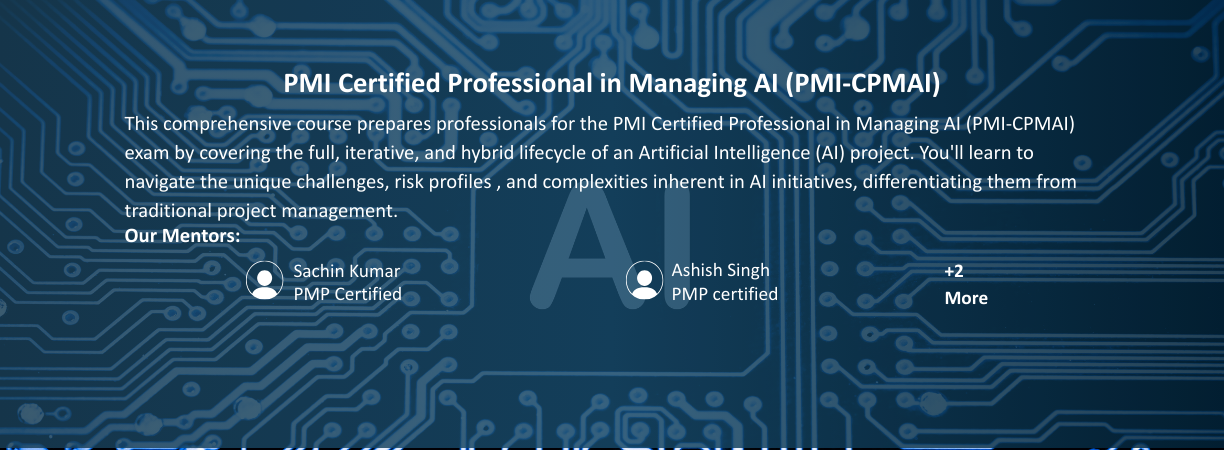
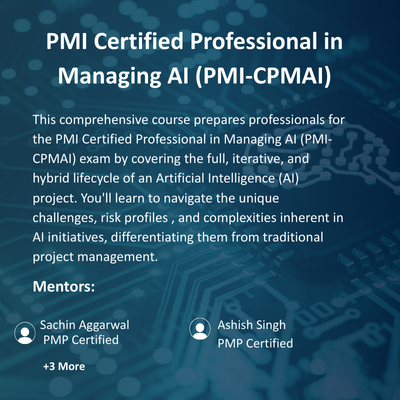
That's great! Based on the provided PMI Certified Professional in Managing AI (PMI-CPMAI) course outline, here are the description, objectives, and course modules. This comprehensive course prepares professionals for the PMI Certified Professional in Managing AI (PMI-CPMAI) exam by covering the full, iterative, and hybrid lifecycle of an Artificial Intelligence (AI) project. You'll learn to navigate the unique challenges, risk profiles , and complexities inherent in AI initiatives, differentiating them from traditional project management. The curriculum is structured around the Six Phases of the CPMAI Methodology , integrating technical AI fundamentals (ML, DL, GenAI) with critical business understanding, ethical governance , and MLOps operationalization.
Course Module: PMI-CPMAI Course Content Breakdown
1. Introduction, AI Fundamentals, and the CPMAI Mindset
This section sets the foundational context for the entire course.
Focus: Primarily conceptual and informational, covering course navigation, exam blueprint, and study strategies.
Key Topics: Defining Artificial Intelligence (AI), its sub-fields (ML, DL), Generative AI models, and the Seven Foundational AI Patterns.
AI Project Context: Understanding why AI projects are unique, the difference between CPMAI and Traditional Project Management, and the roles of the AI Project Manager.
Hands-on Component: Includes real-world examples of AI in industry.
2. Phase I - Business Understanding & AI Strategy
This phase is largely focused on high-level business strategy and alignment.
Problem & Vision: Identifying and defining the business problem, formulating the AI Vision, and aligning AI goals with organizational strategy.
Business Case & ROI: Developing the AI Business Case, quantifying business value (e.g., cost-savings/efficiency gains), and performing high-level risk assessment.
Project Scoping & Fit: Discussing project types (PoC, Pilot, Scale), using the AI Pattern Fit Matrix, and defining Go/No-Go Gates.
Data Scoping Activity: Requires an initial preliminary data assessment.
3. Phase II & III - Data Understanding & Preparation
This is a comprehensive section with significant hands-on activities, as it covers the core data work for the project.
Data Understanding: Activities include data inventory creation, assessing data feasibility, and exploratory data analysis (EDA). Conceptual topics include the Big Data 4Vs and Data Quality Dimensions.
Data Preparation Scoping: Planning for data cleansing, feature engineering, and calculating data quality metrics.
Execution & Pipelines: Many chapters are hands-on, including normalization/standardization, handling missing values, ETL/ELT pipeline concepts, and data labeling management. Conceptual topics cover securing sensitive data and storage solutions.
4. Phase IV - Model Development & Iteration
This section covers the core technical building of the AI model, balancing conceptual selection with hands-on training.
Algorithm Selection: All sub-topics are conceptual, discussing supervised vs. unsupervised learning, classification vs. regression, and deep learning architectures.
Model Training: All core training topics are hands-on, including the model training process, train/validation/test splits, hyperparameter tuning, and cross-validation. Conceptual topics focus on mitigation strategies (overfitting/underfitting).
Generative AI in Projects: Understanding LLMs (conceptual) is followed by practical activities like prompt engineering basics, fine-tuning models, and Retrieval-Augmented Generation (RAG).
5. Phase V - Model Evaluation & Validation
This phase moves from hands-on technical measurement to conceptual business validation.
Technical Evaluation: Focuses on practical application of metrics, including the Confusion Matrix, ROC & AUC, and comparing baseline vs. model performance. Conceptual topics include Accuracy, Precision & Recall, and F1-Score.
Business & Value Check: Entirely conceptual, covering mapping metrics to business KPIs, calculating business impact, and evaluating the Minimum Viable Model (MVM).
Iteration & Re-planning: Mostly conceptual, discussing how to iterate, retrain, pivot, and perform root cause analysis based on validation results.
6. Phase VI - Operationalization & MLOps
This final phase of the CPMAI methodology covers deployment and ongoing management.
Deployment Strategies: Primarily conceptual, introducing MLOps, CI/CD, deployment archetypes, and rollback planning.
Monitoring & Drift: Includes hands-on parts for implementing thresholds & alerts and auto retraining triggers. Conceptual topics define Data Drift and Model Drift.
Integration & Change: Focuses on business and process conceptual topics, like integrating model outputs, organizational change management, and project closure.
7. Trustworthy AI & Ethical Governance
This section is critical for modern AI management and is primarily conceptual, with key hands-on governance checks.
Bias & Fairness: Identifying bias sources and mitigation strategies (conceptual). Includes the practical activity of conducting a bias audit.
Transparency & Security: Covers Explainability (conceptual) and XAI techniques (practical). Other topics include Model Card Documentation and Adversarial Security (conceptual).
Regulatory Compliance: Entirely conceptual, covering Global AI Regulations, PMI Ethics & Conduct, and the role of the AI PM in compliance.
Course Objective:
Upon completing this course, participants will be able to:
· Define and Contextualize AI: Understand AI fundamentals, its sub-fields (ML, DL) , key terminology , and the specific nature of AI projects (the "AI Paradox").· Establish Business Value: Identify suitable business problems , formulate an AI vision , develop a robust AI business case , and quantify expected business value and ROI.
· Manage Data Lifecycle: Oversee data inventory, feasibility , quality, and preparation activities, including data cleansing, feature engineering , and ETL/ELT pipeline concepts.
· Direct Model Development: Guide the team through algorithm selection , model training (including hyperparameter tuning and cross-validation) , and manage Generative AI projects (LLMs, Prompt Engineering).
· Evaluate and Validate Models: Conduct thorough technical evaluations using metrics like the Confusion Matrix, Precision, Recall, and ROC/AUC , and validate the model against business KPIs and the Minimum Viable Model (MVM).
· Operationalize AI Solutions: Understand MLOps principles, deployment strategies , and implement monitoring for data and model drift to ensure continuous performance.
· Govern Trustworthy AI: Apply principles for managing bias and fairness , ensuring transparency (Explainability/XAI) , and maintaining regulatory compliance and ethical conduct.

Upcoming Batches: Choose as per Your Requirement
Our Mentors:
Richa Gupta


PMP
Sachin kumar
ATP Instructor, PMP
Ahmed Khan
PMP
Abhishek Singh
PMP
Our Mentors:

Richa Gupta
Cloud Engineer in Wipro
Aina Rathor
DevOps Engineerex-Deloitte
Ahmed Khan
Coud Engineer in Cognizant
Coud Engineer in IBM
Abhishek Singh
Our Alumni Work at Top Companies













































PMI-CPMAI Course FAQs
1. What is the overall structure of the CPMAI course?
The course is structured around the Six Phases of the CPMAI Methodology , covered across Sections 2 through 6. The course begins with an introduction and AI fundamentals (Section 1) , and concludes with a section on Trustworthy AI and Ethical Governance (Section 7) and final exam preparation.
2. What are the Six Phases of the CPMAI Methodology covered in the course?
The six phases align with the main sections of the curriculum:
Phase I: Business Understanding & AI Strategy (Section 2)
Phase II & III: Data Understanding & Preparation (Section 3)
Phase IV: Model Development & Iteration (Section 4)
Phase V: Model Evaluation & Validation (Section 5)
Phase VI: Operationalization & MLOps (Section 6)
3. Does the course cover Generative AI (GenAI)?
Yes, the course introduces Generative AI (GenAI) Models in the AI Fundamentals section. It also dedicates a full module in Phase IV to Generative AI in Projects, covering topics like understanding LLMs, Prompt Engineering Basics, Fine-Tuning Models, and Retrieval-Augmented Generation (RAG).
4. How much hands-on or practical experience is included?
Practical activities are integrated throughout the phases, primarily focusing on data and model work. Phase II & III (Data) is noted for containing the most practical, hands-on activities, such as Data Inventory Creation, Exploratory Data Analysis (EDA), Normalization/Standardization, and ETL/ELT Pipeline Concepts.
5. Which section is most focused on business and conceptual knowledge?
Section 2: Phase I - Business Understanding & AI Strategy is largely focused on high-level business theory. Topics include formulating the AI Vision, developing the AI Business Case, quantifying business value, and defining project scope.
6. What topics are covered in the MLOps and deployment phase (Phase VI)?
Phase VI covers Operationalization & MLOps. Key topics include an introduction to MLOps & CI/CD, deployment archetypes, Data Drift and Model Drift. It also includes hands-on parts for implementing Thresholds & Alerts and Auto Retraining Triggers.
7. Does the course address AI ethics and compliance?
Yes, Section 7: Trustworthy AI & Ethical Governance is dedicated to these critical topics. It covers identifying and mitigating Bias & Fairness , ensuring Transparency through Explainability (XAI) Techniques and Model Card Documentation , and addressing Global AI Regulations and PMI Ethics.
8. What evaluation metrics are taught in the course?
The course covers both Technical Evaluation and Business Value Check. Technical metrics include the Confusion Matrix, Accuracy, Precision & Recall, F1-Score, ROC & AUC, and Regression Metrics. Business validation involves Mapping Metrics to KPIs.
9. Who is the target audience for this course?
The course is designed for professionals managing AI initiatives, focusing on the Role of the AI Project Manager and the differences between CPMAI vs. Traditional Project Management. It prepares individuals for the PMI-CPMAI exam.
10. How does the course prepare me for the CPMAI exam?
The course blueprint aligns with the CPMAI domains. The final section, Conclusion & Exam Preparation, includes a Review of CPMAI Domains, Top 10 Exam Tips, Practice Exam Strategy, and a Last-Minute Checklist.

Our Programs
© 2025 GIMIT | All rights Reserved