Major Industry Recruiters
Major Industry Recruiters
Course Description:
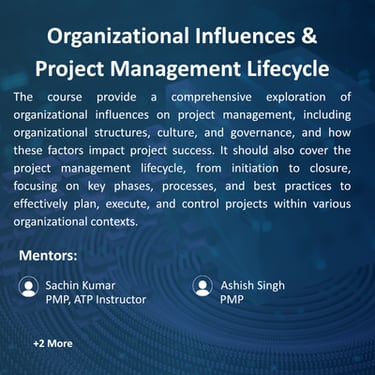
The course provide a comprehensive exploration of organizational influences on project management, including organizational structures, culture, and governance, and how these factors impact project success. It should also cover the project management lifecycle, from initiation to closure, focusing on key phases, processes, and best practices to effectively plan, execute, and control projects within various organizational contexts.
Course Objective:
Project Management is no longer just about checking off tasks on a list. In 2025, successful Project Managers are Strategic Leaders. They understand that a project does not exist in a vacuum—it lives inside a complex living ecosystem called an Organization.
This course bridges the gap between technical process and strategic reality. We move beyond the textbook to explore the invisible forces that actually determine project success: Culture, Structure, and Governance.
Master the Business Environment: Analyze how organizational structures (Functional, Matrix, Projectized) directly impact project authority, resource availability, and success.
Navigate Corporate Governance: Understand the frameworks, policies, and cultural norms that dictate project decision-making and strategy execution in top-tier companies.
Lead Through the Full Lifecycle: Expertly manage projects from Initiation (Charters & Stakeholders) to Planning, Execution, Monitoring, and Closure.
Strategic Alignment: Learn to align project outputs with organizational strategy to deliver tangible business value, a key skill for the 2025 PMP® Exam.
Adaptive Project Management: Distinguish between Predictive (Waterfall) and Adaptive (Agile) lifecycles and select the right approach for your organization’s context.
Stakeholder Mastery: Identify, analyze, and engage internal and external stakeholders by understanding their power and influence within the corporate hierarchy.
Course Module:
The training is structured around the core skills.:
Section 1: The Project Management Context and Environment
· Chapter 1.1: Defining the Organizational Ecosystem: Internal vs. External Factors
Chapter 1.2: What is Project Success? Metrics beyond Triple Constraints
· Chapter 1.3: Enterprise Environmental Factors (EEFs) vs. Organizational Process Assets (OPAs)
· Chapter 1.4: The Role of the Project Manager as a Boundary Spanner and Navigator
Section 2: Understanding organizational Structures and Their Impact
· Chapter 2.1: Functional, Projectized, and Matrix Organizations: A Deep Dive
· Chapter 2.2: Navigating Matrix Structures (Weak, Balanced, and Strong)
· Chapter 2.3: Modern Structures: Hybrid, Organic, and Virtual Organizations
· Chapter 2.4: How Organizational Structure Influences Authority, Resources, and Communication
· Chapter 2.5: Tailoring Project Methodology to the Organizational Structure
Section 3: Organizational Culture, Governance, and PMOs
· Chapter 3.1: Defining Organizational Culture: Values, Norms, and Beliefs
· Chapter 3.2: The Impact of Culture on Risk Tolerance, Collaboration, and Change Management
· Chapter 3.3: Introduction to Organizational Project Governance and Oversight
· Chapter 3.4: The Project Management Office (PMO): Types, Functions, and Value
· Chapter 3.5: Stakeholder Identification, Analysis, and Engagement in a Complex Organization
Section 4: Project Initiation and Detailed Planning
· Chapter 4.1: The Initiating Phase: Business Case, Needs Assessment, and Project Charter
· Chapter 4.2: Detailed Scope Management: WBS Creation and Scope Baseline
· Chapter 4.3: Schedule Development: Critical Path Method (CPM) and Agile Planning
· Chapter 4.4: Cost Baseline and Budget Development (Estimating Techniques and Contingency Reserve)
· Chapter 4.5: Integrated Planning: Crafting the Comprehensive Project Management Plan
Section 5: Execution, Monitoring, and Controlling the Work
· Chapter 5.1: Directing and Managing Project Work (Executing the Plan)
· Chapter 5.2: Managing Team Performance and Developing the Project Team
· Chapter 5.3: Quality Assurance and Control Techniques
· Chapter 5.4: Performance Measurement: Earned Value Management (EVM) and Variance Analysis
· Chapter 5.5: Controlling Scope, Schedule, and Cost: Integrated Change Control Process
Section 6: Project Closure and Continuous Improvement
· Chapter 6.1: Project or Phase Closure: Transitioning Deliverables and Final Sign-off
· Chapter 6.2: Administrative Closure: Finalizing Procurement and Updating OPAs
· Chapter 6.3: Conducting Lessons Learned: Process, Artifacts, and Repository Management
· Chapter 6.4: Measuring the Value Realization and Benefits Management after Project Completion
· Chapter 6.5: Ethical Considerations and Professional Conduct in Project Closure
Course Overview:
Are you a Project Manager who feels like you’re "flying blind" inside your own company?
Do you struggle to get resources because you don't understand the political landscape? Are you confused by how your project fits into the "Big Picture" of your organization’s strategy? Or perhaps you are preparing for the PMP® Exam and dreading the vague questions on "Business Environment" and "Governance"?
Welcome to the definitive guide on Organizational Influences & the Project Management Lifecycle.
Project Management is no longer just about checking off tasks on a list. In 2025, successful Project Managers are Strategic Leaders. They understand that a project does not exist in a vacuum—it lives inside a complex living ecosystem called an Organization.
This course bridges the gap between technical process and strategic reality. We move beyond the textbook to explore the invisible forces that actually determine project success: Culture, Structure, and Governance.

Upcoming Batches: Choose as per Your Requirement
Our Mentors:
Richa Gupta


PMP
Arshi Kumari
CAPM and PMP
Ahmed Khan
PMP
Sachin Kumar
ATP Instructor
Our Mentors:

Sachin Kumar
ATP Instructor, PMP
Aina Rathor
PMP
Ahmed Khan
CAPM, PMP
PMP
Abhishek Singh
Our Alumni Work at Top Companies









































1. How does this course help with the 2025 PMP® Exam?
This course specifically targets the "Business Environment" domain, which now makes up 8% of the PMP exam. We cover the critical topics of organizational strategy, compliance, and value delivery that many older courses miss.
2. What is the difference between "Project Lifecycle" and "Product Lifecycle"?
A Project Lifecycle (Initiation to Closing) focuses on doing the work to deliver a result. A Product Lifecycle (Introduction, Growth, Maturity, Decline) focuses on the value the result creates over time. This course teaches you how to align both to maximize business value.
3. I work in a Matrix Organization. Will this help me manage my boss?
Yes!
We dedicate a full module to Organizational Structures. You will learn how to navigate "Matrix" environments where you share authority with functional managers, giving you strategies to negotiate for resources without formal power.
4. Do you cover Agile or Waterfall lifecycles?
We cover both, plus Hybrid approaches. You will learn the Predictive (Waterfall) lifecycle for stable environments and Adaptive (Agile) lifecycles for high-change environments, helping you choose the right method for your organization.
5. What exactly is "Project Governance" and why do I need it?
Project Governance is the framework that tells you who makes decisions and how risks are escalated. Understanding governance is the #1 way to get your projects approved and supported by senior leadership.
6. Is this course suitable for absolute beginners?
Absolutely. We start with Project Management 101, defining the fundamental phases (Initiation, Planning, Execution, Monitoring, Closing). No prior experience is required, but it is also deep enough for experienced PMs to fill knowledge gaps.
7. How does Organizational Culture affect my project?
Culture eats strategy for breakfast! We teach you how to assess your company’s "Cultural Norms"—is it risk-averse or innovative? Understanding this helps you tailor your communication style to get stakeholder buy-in faster.
8. Will I get a certificate of completion?
Yes, you will receive a verifiable Udemy Certificate of Completion that you can add to your LinkedIn profile and resume to demonstrate your competency in Strategic Project Management.
9. What are "Enterprise Environmental Factors" (EEFs)?
EEFs are the internal and external conditions (like market conditions, software tools, or political climate) that you cannot control but must manage. This course provides a checklist of EEFs so you never get blindsided by external risks.
10. Does this course include real-world templates?
Yes. You will get downloadable resources, including a Project Charter Template, a Stakeholder Register, and a Governance Framework Checklist that you can immediately apply to your current job.

Our Programs
© 2025 GIMIT | All rights Reserved