

Major Industry Recruiters


Major Industry Recruiters
Course Description:
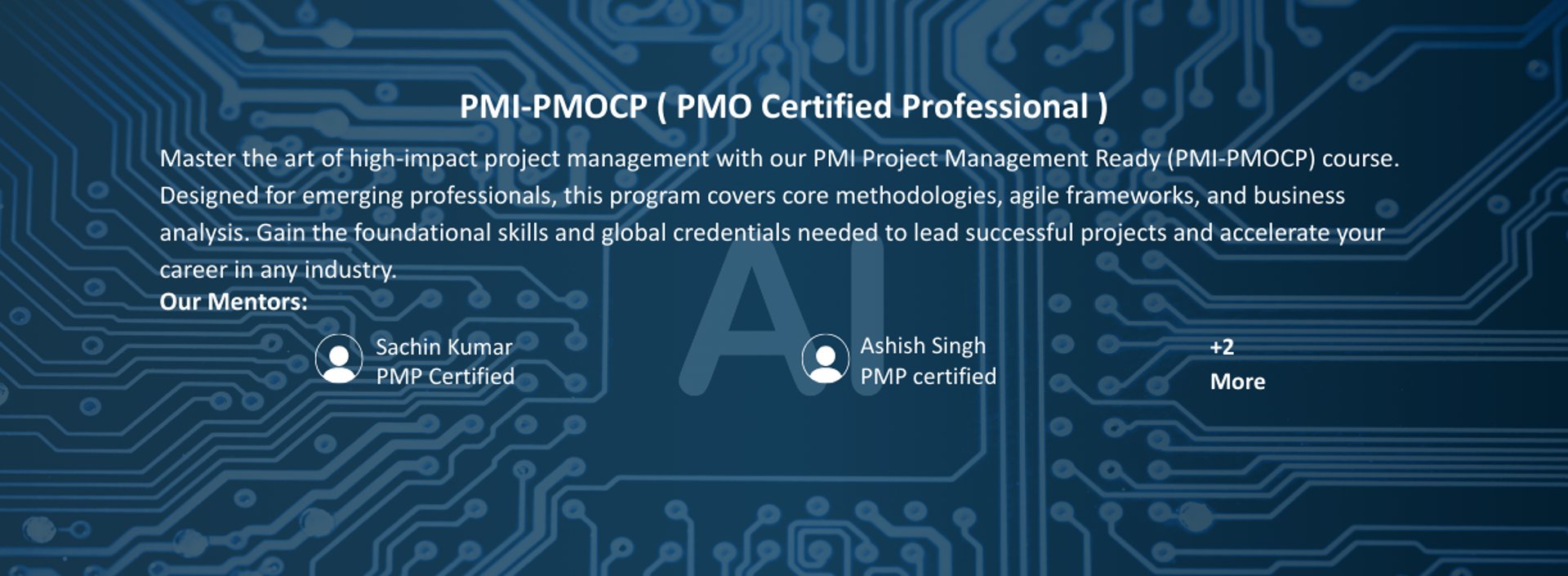
Elevate your professional trajectory with our comprehensive PMI Project Management Ready (PMI-PMOCP) course. This program is meticulously designed for students and entry-level professionals looking to master the fundamental pillars of project management, including Predictive (Waterfall), Agile, and Business Analysis frameworks.
Through industry-aligned curriculum, you will gain a command of project lifecycles, resource management, and effective communication strategies. This course doesn't just teach theory; it equips you with the practical mindset required to solve real-world challenges. Secure a globally recognized credential from the Project Management Institute (PMI) and demonstrate your readiness to lead successful projects in any competitive landscape.
Course Module: PMI-ACP (Agile Certified Practitioner)
Section 1: Project Management Fundamentals
This section introduces the foundational "language" of projects and the environment in which they thrive.
Chapter 1: The World of Projects – Defining what a project is (and isn’t), project vs. operations, and the value of project management.
Chapter 2: The Project Manager’s Role – Exploring the competencies, leadership styles, and ethical responsibilities of a PM.
Chapter 3: Project Environments – Understanding organizational structures, cultures, and how they influence project success.
Chapter 4: The Project Life Cycle – A high-level look at the phases from initiation and planning to execution and closing.
Section 2: Traditional Plan-Based Methodologies
Focusing on the "Waterfall" approach, this section covers projects with well-defined requirements and linear paths.
Chapter 5: Defining Project Scope – Creating the Work Breakdown Structure (WBS) and setting clear boundaries.
Chapter 6: Schedule and Resource Management – Building a project timeline, identifying the critical path, and assigning the right people to tasks.
Chapter 7: Budgeting and Cost Control – Estimating costs, managing the budget, and tracking financial health.
Chapter 8: Risk and Quality Management – Identifying potential threats and ensuring the final deliverable meets quality standards.
Section 3: Agile Frameworks and Iterative Delivery
This section shifts to adaptive environments where change is constant and speed-to-market is a priority.
Chapter 9: The Agile Mindset – Understanding the Agile Manifesto, its core values, and the 12 principles.
Chapter 10: Scrum Basics – Roles (Product Owner, Scrum Master, Team), Artifacts, and Ceremonies like the Sprint and Daily Stand-up.
Chapter 11: Kanban and Visualizing Work – Managing flow, limiting Work in Progress (WIP), and using visual boards.
Chapter 12: Adaptive Planning – How to plan in increments and handle changing priorities through backlogs.
Section 4: Business Analysis Frameworks
This final section ensures that the project output actually solves the business problem it was intended to fix.
Chapter 13: The Role of the Business Analyst – Defining the BA’s unique contribution to the project team.
Chapter 14: Stakeholder Engagement – Identifying who matters most and how to manage their expectations.
Chapter 15: Requirements Life Cycle – From elicitation (gathering) and analysis to documentation and validation.
Chapter 16: Delivering Business Value – Ensuring the project's final solution aligns with the organization's strategic goals.
Course Objective:
Master Core Methodologies: Develop a deep understanding of the differences between Traditional (Waterfall), Agile, and Hybrid project management approaches.
Navigate Project Lifecycles: Learn to manage a project from initiation and planning through to execution, monitoring, and successful closing.
Adopt Business Analysis: Gain the ability to identify stakeholder needs and define project requirements that align with organizational goals.
Enhance Soft Skills: Cultivate essential leadership qualities, including professional accountability, conflict resolution, and effective team communication.
Certification Readiness: Fully prepare for the PMI Project Management Ready™ examination by mastering the official domains and terminology.

Upcoming Batches: Choose as per Your Requirement
Our Mentors:
Richa Gupta


PMP
Sachin kumar
ATP Instructor, PMP
Ahmed Khan
PMP
Abhishek Singh
PMP
Our Mentors:

Richa Gupta
Cloud Engineer in Wipro
Aina Rathor
DevOps Engineerex-Deloitte
Ahmed Khan
Coud Engineer in Cognizant
Coud Engineer in IBM
Abhishek Singh
Our Alumni Work at Top Companies











































Frequently Asked Questions (FAQs) for the PMI-PBA Course
1. What is the PMI Project Management Ready (PMI-PMOCP) certification?
It is an entry-level credential from the Project Management Institute (PMI) designed for students and early-career professionals. It introduces the core concepts of project management across traditional, agile, and business analysis methodologies.
2. Who is the ideal candidate for this course?
This course is perfect for high school or college students, recent graduates, and individuals looking to transition into a project-related role. No prior project management experience is required.
3. Does this course cover Agile and Waterfall?
Yes. The curriculum is uniquely balanced. It covers Traditional (Waterfall) methods for predictable projects and Agile frameworks (like Scrum and Kanban) for fast-paced, evolving environments.
4. What is the difference between this and the CAPM® certification?
The PMI Project Management Ready is an introductory "literacy" certification, while the Certified Associate in Project Management (CAPM) is more advanced. Think of this course as the perfect stepping stone to the CAPM.
5. Will I learn about Business Analysis in this course?
Absolutely. One entire section is dedicated to Business Analysis frameworks. You will learn how to identify stakeholder needs and ensure that the project’s output actually solves a business problem.
6. Are there any prerequisites for taking the exam?
There are no professional experience prerequisites. You simply need to be able to read and understand the course material, making it the most accessible PMI credential available.
7. How is the final certification exam structured?
The official PMI exam typically consists of 40–50 questions that must be completed within 50 minutes. It tests your knowledge of the four main domains covered in our course modules.
8. What kind of jobs can I get after finishing this course?
While it is an entry-level credential, it prepares you for roles such as Project Coordinator, Junior Project Manager, Team Lead, or Business Assistant. It shows employers you understand the "language" of project delivery.
9. How long does it take to complete the course?
The course is self-paced, but most students find they can master the material and feel "exam-ready" within 20 to 30 hours of dedicated study.
10. Is this certification recognized globally?
Yes. Because it is issued by the Project Management Institute (PMI)—the world’s leading authority on project management—the credential carries weight with employers and academic institutions worldwide.

Our Programs
© 2025 GIMIT | All rights Reserved